


As a professional manufacturer in the home and garden decorative lighting sector, XINSANIXNG Lighting brings 19 years of experience in product R&D and manufacturing, backed by comprehensive service support. Our extensive export experience helps you save time and effort.
Lighting Product Certifications Explained: CE vs UL vs ETL vs SAA – Which Certification Do You Really Need?
One of the most common questions buyers ask before importing lighting products is: "Which certification do I actually need?". The answer depends on where you plan to sell your products—not where they are manufactured.
Many first-time importers mistakenly believe that every lighting product must have every certification. In reality, each certification is designed for a specific market, and obtaining unnecessary certifications increases costs without adding value.
This guide explains the four most common lighting certifications—CE, UL, ETL, and SAA—in plain language, helping you choose the right certification before placing an order.
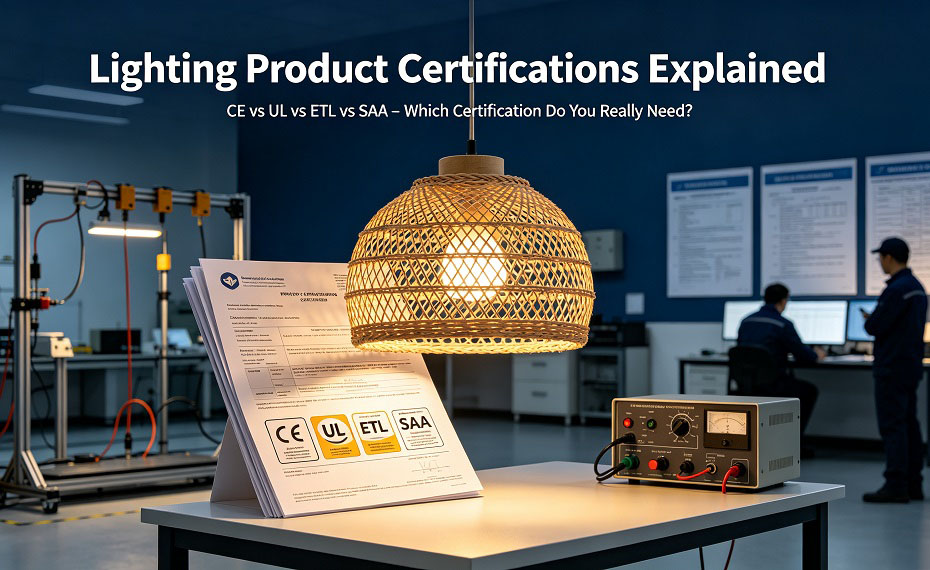
The Quick Answer
If you're in a hurry, this table tells you almost everything you need to know.
| Certification | Required Market | Mandatory? | Who Usually Requests It? |
| CE | European Union | Yes | EU importers |
| UL | United States | Often required by retailers and inspectors | North American brands |
| ETL | United States & Canada | Accepted alternative to UL | Importers, Amazon sellers |
| SAA | Australia & New Zealand | Yes (for many products) | Australian distributors |
For most buyers, the destination market determines the certification—not the manufacturer.
What Is CE Certification?
CE is not a quality award. It simply means the product meets European Union safety, health, and environmental requirements.
If you're selling lighting products within the EU, CE marking is generally required before products can legally enter the market.
Typical Markets
· Germany
· France
· Italy
· Spain
· Netherlands
· Sweden
· Most EU countries
CE Covers
· Electrical safety
· EMC (Electromagnetic Compatibility)
· RoHS compliance (often paired)
· Product documentation
· Buyers Should Know

Many buyers ask suppliers: "Do you have CE?"
A better question is: "Is this specific product tested and documented for CE compliance?"
Certification applies to individual products—not an entire factory.
What Is UL Certification?
UL stands for Underwriters Laboratories, one of the best-known safety organizations in North America.
Unlike CE, UL focuses heavily on electrical safety testing. Large retailers, commercial projects, and electrical inspectors often specify UL-certified products.
Typical Applications
· Residential lighting
· Commercial buildings
· Hotels
· Restaurants
· Retail stores
UL certification can improve buyer confidence, but not every lighting product sold in the United States legally requires UL. Many retailers, however, choose to require it as part of their purchasing standards.
What Is ETL Certification?
ETL is often misunderstood. Many buyers assume ETL is "lower quality" than UL. That is incorrect. Both certifications test products against the same recognized safety standards. The difference lies in the testing organization—not the safety requirements.
This means:
· ETL is widely accepted in North America.
· Electrical inspectors generally accept ETL-certified products.
· Many retailers accept either UL or ETL.

For many importers, ETL offers a practical alternative when working with qualified manufacturers.
UL vs ETL: Which Should You Choose?
For most buyers, there is no need to agonize over which certification is "better." Instead, you should determine whether the customer explicitly requires UL certification, whether ETL certification complies with local regulations, and whether your distributor mandates one of these certifications.
Be sure to confirm certification requirements with the customer before production begins.
What Is SAA Certification?
If you plan to sell lighting products in Australia or New Zealand, SAA is one of the certifications you are likely to encounter.
Australian electrical regulations are among the strictest in the world.
Importers should confirm:
· Plug type
· Voltage
· Electrical components
· Product registration requirements
Never assume a CE or UL-certified product automatically satisfies Australian regulations.

Which Certification Do You Need?
The easiest decision framework is this:
| Where You Sell | Recommended Certification |
| European Union | CE + RoHS |
| United States | UL or ETL |
| Canada | ETL or cETL (depending on requirements) |
| Australia | SAA |
| Middle East | Confirm with local regulations |
| Southeast Asia | Depends on country-specific requirements |
Never begin production until your target certification has been confirmed. Changing electrical components after manufacturing is far more expensive than specifying the correct requirements at the quotation stage.
Common Certification Mistakes Buyers Make
Assuming Every Product Is Already Certified
Factories may have certified one model—but not every model. Always ask for documentation relating to the exact product you are purchasing.
Waiting Until Production Is Finished
Certification requirements should be discussed before:
· Sampling
· Material purchasing
· Production
Not after.
Confusing Factory Certification with Product Certification
A factory may operate under a quality management system, but that does not automatically certify every lighting product it manufactures.
Assuming Lower Price Means Easier Certification
Cheaper electrical components often fail testing.
Choosing certified components from the beginning usually saves time and money.
How XINSANXING Supports International Certification Requirements
XINSANXING Lighting Factory works with customers across Europe, North America, Australia, and other international markets.
During product development, the team helps buyers confirm certification requirements before production starts, reducing the risk of redesigns and shipment delays.
Support includes:
· Product specification review
· Electrical component selection
· Documentation preparation
· OEM & ODM development
· Export experience for multiple markets


Frequently Asked Questions
No. CE is intended for the European market. U.S. buyers typically request UL or ETL certification.
Yes. ETL tests products to the same recognized safety standards as UL. The difference is the testing organization.
Requirements depend on the destination market and product type. Always confirm regulations before production.
Yes. Many lighting products are certified for multiple markets to simplify international sales.
Ultimately, the importer or brand owner should confirm market requirements, while the manufacturer can help prepare products to meet those requirements.
Before sampling and certainly before mass production begins.
Conclusion
Lighting certifications are not about collecting as many logos as possible—they are about ensuring that your products comply with the regulations of the markets where they will be sold.
By identifying your target market first, confirming certification requirements early, and working with an experienced manufacturer, you can avoid unnecessary costs, production delays, and customs issues.
The best sourcing decisions are made before production begins, not after the products are ready to ship.
Looking for a professional rattan lamp manufacturer?
Recommended Content:
If You Are in Business, You May Like
Post time: Jul-04-2026