


As a specialized manufacturer of rattan and bamboo lighting, XINSANIXING Lighting brings 19 years of experience in product R&D and manufacturing, backed by comprehensive service support. Our extensive export experience helps you save time and effort.
If you put a rattan pendant light and a bamboo pendant light next to each other, the difference may initially seem cosmetic. Both are natural. Both can be woven by hand. Both work well in hotels, restaurants, resorts, retail spaces, and residential interiors.
But from a manufacturing perspective, rattan lamps and bamboo lamps behave very differently. That difference affects much more than appearance. It influences what shapes can be produced, how the shade is constructed, how light passes through it, how easily a design can be customized, how consistent a large order will look, and how the finished fixture should be used and maintained.
So, Rattan vs Bamboo Lighting: Which Is Better?
There isn't a universal winner. For a buyer, designer, or hospitality project, the better question is: Which material is better suited to the design, environment, quantity, and visual effect of this particular project?
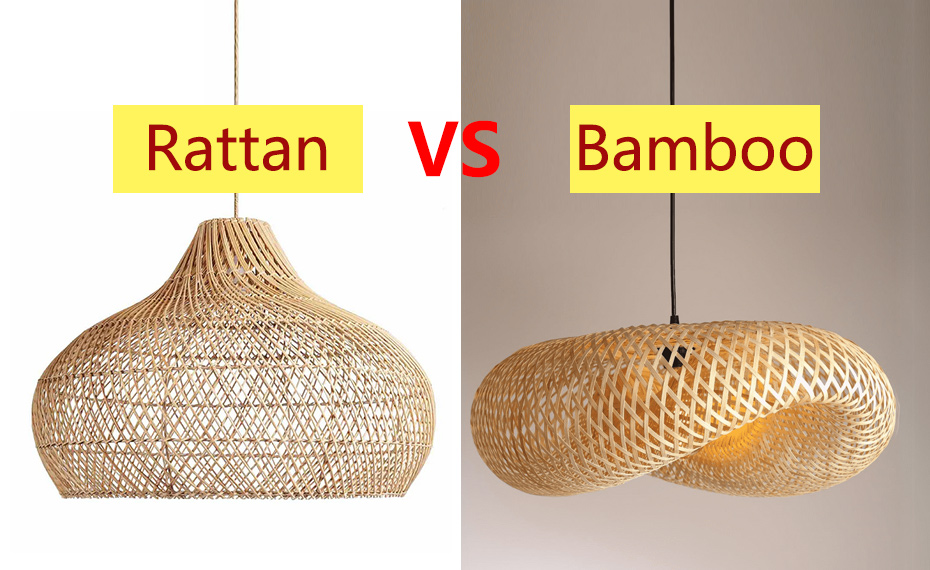
This guide answers that question from a manufacturing and sourcing perspective rather than simply comparing two decorating styles.
Rattan vs Bamboo Lighting: The 30-Second Answer
For buyers who need a quick decision:
| Project Requirement | Rattan | Bamboo |
| Curved or sculptural shapes | ★★★★★ | ★★★ |
| Fine handwoven patterns | ★★★★★ | ★★★★ |
| Structured geometric forms | ★★★★ | ★★★★★ |
| Soft patterned shadows | ★★★★★ | ★★★★ |
| Architectural linear appearance | ★★★ | ★★★★★ |
| Complex custom weaving | ★★★★★ | ★★★★ |
| Natural handmade character | ★★★★★ | ★★★★★ |
| Large statement pendants | ★★★★★ | ★★★★★ |
| Japandi / Asian-inspired projects | ★★★★ | ★★★★★ |
| Boho / coastal / resort projects | ★★★★★ | ★★★★ |
The stars aren't quality scores. They show where each material naturally performs best.
Choose rattan when the design depends on curves, intricate weaving, organic forms, and softer visual texture.
Choose bamboo when the design calls for stronger lines, visible structure, geometric rhythm, and a more architectural character.
And sometimes, the best answer is to use both materials in the same fixture.
The Difference Starts Inside the Material
Rattan and bamboo are frequently grouped together because both are associated with natural woven products. Botanically and structurally, however, they're very different.
Rattan comes from climbing palms. The stems are generally solid and flexible enough to bend and weave into curved structures.
Bamboo is a grass. Its mature culms are typically hollow between nodes and considerably more rigid.
That structural difference is the starting point for almost everything that follows. Think of it this way:
Rattan naturally wants to bend.
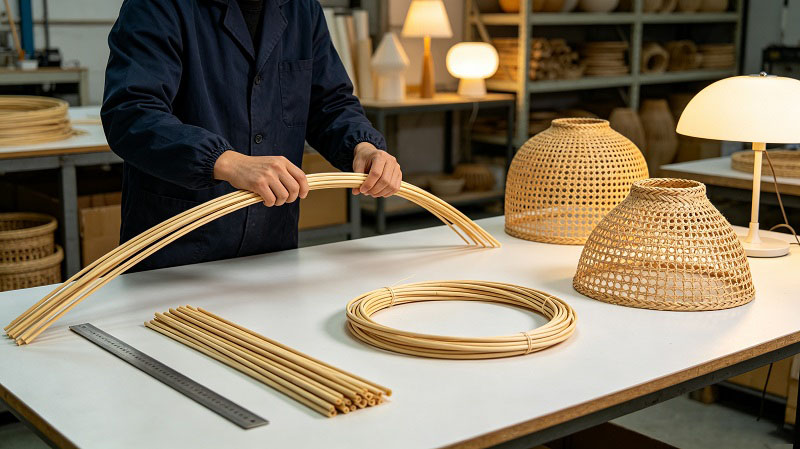
Bamboo naturally wants to provide structure.
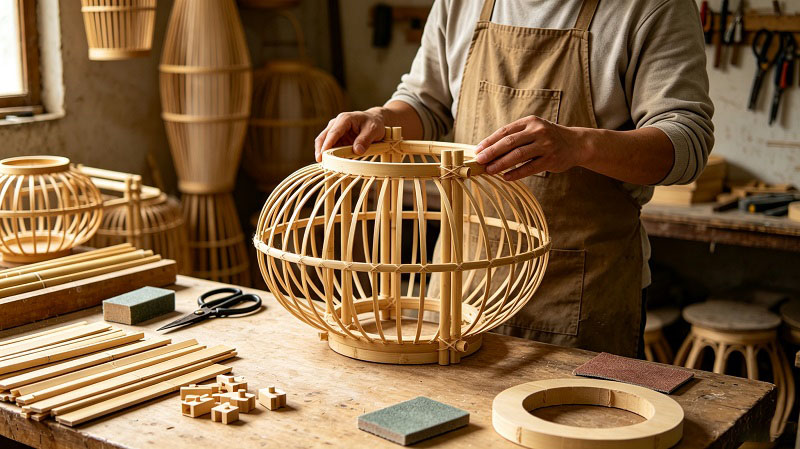
For lighting designers, that distinction matters more than whether one material looks slightly darker or lighter.
1. Design Freedom: Rattan Has the Advantage for Complex Curves
When a customer sends us a sketch for a new woven lamp, one of the first questions isn't about price. It's: Can the chosen material actually produce this shape reliably? This is where rattan often has an advantage.
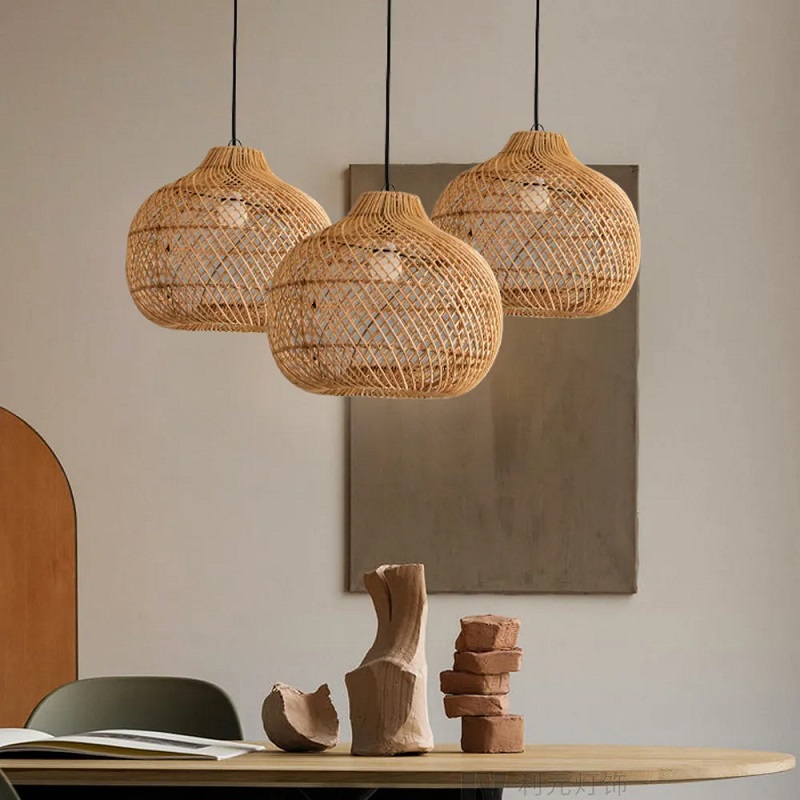
Its flexibility makes it suitable for forms such as:
· Domes
· Bells
· Organic curves
· Hourglass shapes
· Layered shades
· Irregular sculptural forms
· Fine woven surfaces
Bamboo can also be split into strips and woven, so describing it only as a rigid frame material would be inaccurate.
But its natural stiffness lends itself particularly well to:
· Cylindrical forms
· Lantern structures
· Repeated vertical lines
· Geometric shades
· Ribbed structures
· Architectural silhouettes
For an OEM project, the distinction matters. A design that looks excellent on a computer rendering may become difficult, inefficient, or inconsistent when translated into the wrong natural material.
Manufacturer's recommendation: choose the material after reviewing the geometry of the design—not simply because the collection is supposed to be called “rattan” or “bamboo.”
2. The Light Effect Is Really a Weave-Design Decision
Many comparison articles say: rattan gives soft light; bamboo gives stronger shadows. There's some truth to this, but it's incomplete. The material alone doesn't determine the lighting effect.
The following variables matter just as much:
· Width of the strips
· Distance between strips
· Number of woven layers
· Weaving pattern
· Shade diameter
· Bulb position
· Inner diffuser
· Bulb output and color temperature
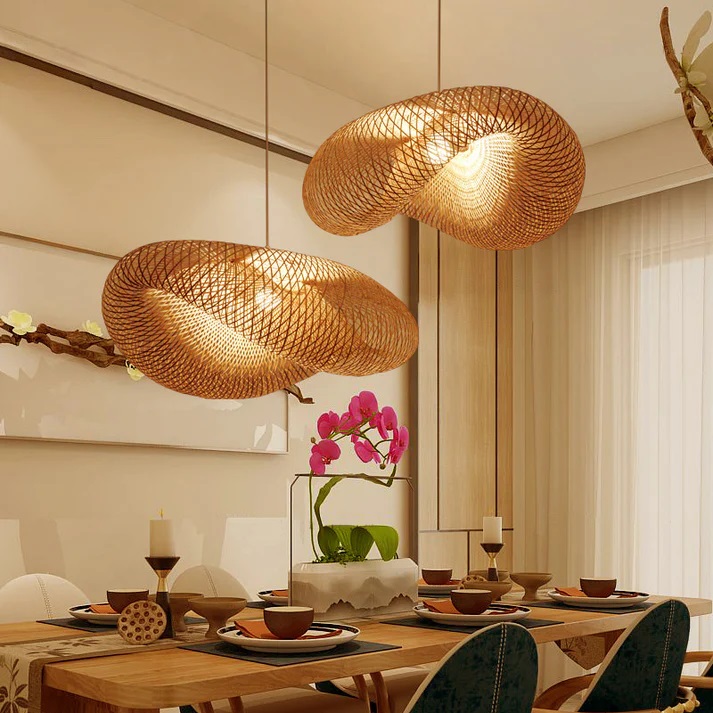
A loosely woven rattan shade can create dramatic shadows.
A tightly constructed bamboo shade can produce a much more controlled effect.
So for project buyers, don't specify only: “We want a warm rattan lamp.”
Specify the actual result: “We want decorative patterned light on the ceiling but limited glare at seated eye level.”
That's information a manufacturer can engineer around.
3. Don't Choose by Interior Style Alone
It's common to see recommendations such as:
· Rattan = Boho
· Bamboo = Japandi
That's useful for inspiration, but too simplistic for professional projects.
Rattan can work in:
· Coastal hotels
· Contemporary restaurants
· Tropical resorts
· Modern organic homes
· Luxury villas
· Scandinavian-inspired interiors
Bamboo can work in:
· Japandi interiors
· Modern restaurants
· Tea houses
· Wellness resorts
· Minimalist hospitality spaces
· Contemporary Asian interiors
Material does not determine style on its own. The deciding factor should be the design language of the fixture, not the material label. A highly geometric rattan pendant may look more contemporary than a traditional bamboo basket shade.
4. For Large Projects, Consistency Needs a Different Definition
This is something buyers often discover only after receiving their first large order of natural-material lighting.
Natural materials are not plastic. You should expect controlled variation in:
· Fiber tone
· Surface texture
· Minor diameter differences
· Natural markings
With handmade products, the goal shouldn't be to eliminate every visible difference. The goal is to establish an acceptable range of variation.
For example, before manufacturing 300 pendants for a hotel project, the buyer and manufacturer can agree on:
· Approved color range
· Maximum dimensional tolerance
· Weave-density reference
· Shape tolerance
· Reference sample
· Acceptable natural markings
That is far more useful than asking the factory to make every piece “100% identical.”
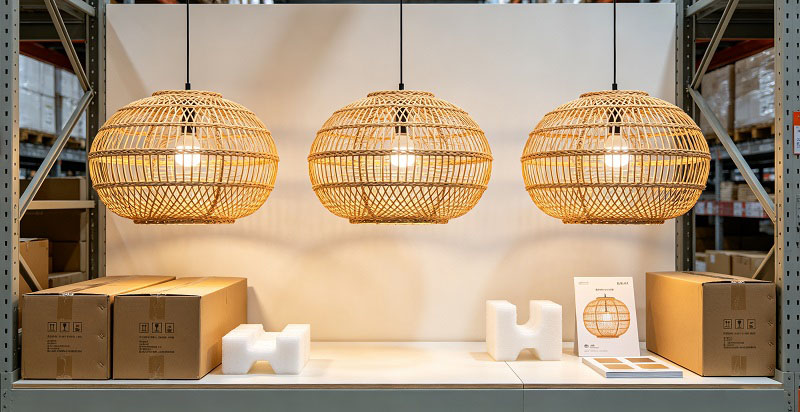
>> Batch quality comparison of handcrafted natural woven pendant lights after inspection <<
5. Durability: “Bamboo Is Stronger” Is Too Simple
Another common online comparison is: Bamboo is stronger; rattan is softer. That statement doesn't tell a professional buyer very much.
A finished lamp's durability depends on the complete construction:
· Material thickness
· Frame design
· Joinery
· Surface treatment
· Weaving tension
· Storage conditions
· Installation environment
· Moisture control
Rattan's flexibility can be an advantage because it tolerates bending during manufacturing.
Bamboo's rigidity is valuable for maintaining structured forms, but improperly prepared bamboo can develop cracking or splitting.
So rather than asking: Which natural material is stronger?
Ask: How has this particular fixture been designed and treated for its intended environment?
That question produces a much more useful answer.
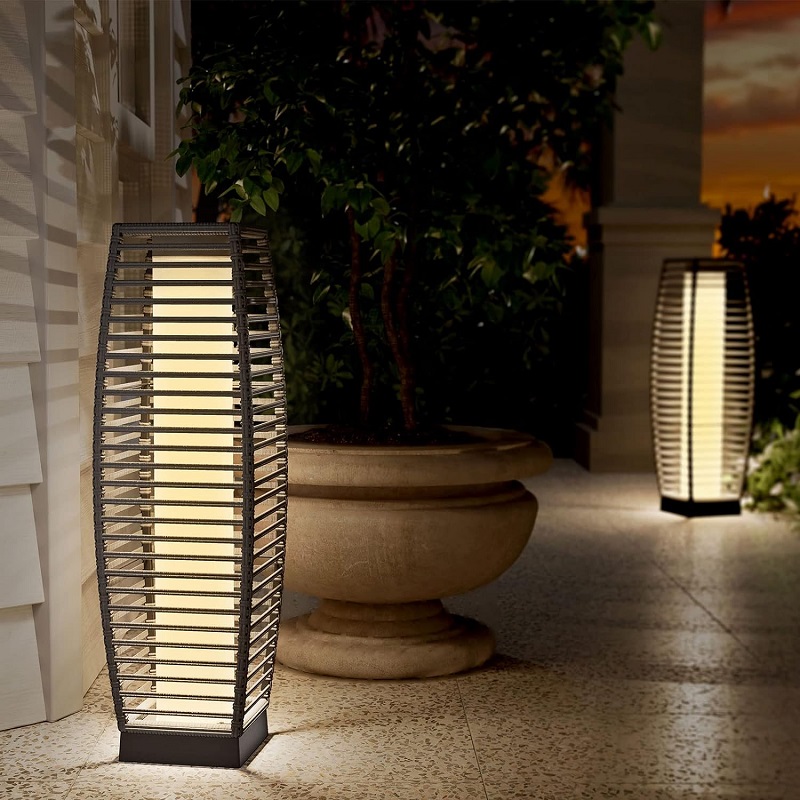
6. Neither Material Should Automatically Be Called “Outdoor Lighting”
This deserves special attention. A lamp being made from bamboo or rattan does not automatically make it suitable for outdoor installation.
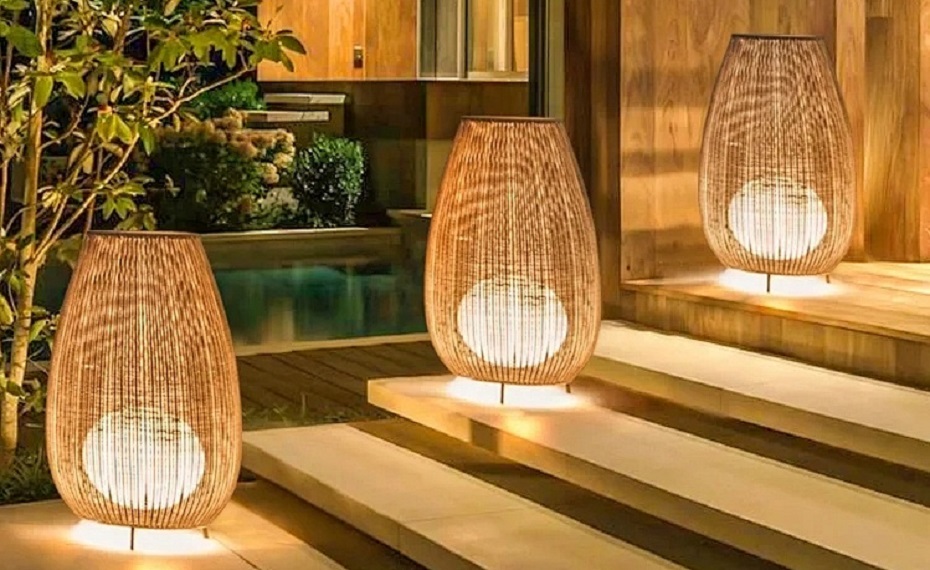
Natural fibers are susceptible to the effects of rain, UV radiation, humidity, and temperature fluctuations. A covered restaurant terrace and a fully exposed garden represent vastly different environments, resulting in significant differences in performance and durability.
For outdoor projects, the manufacturer must evaluate not only the shade material but also:
· Surface treatment
· Metal frame protection
· Lamp holder
· Cable
· Electrical connections
· IP requirements
· Mounting hardware
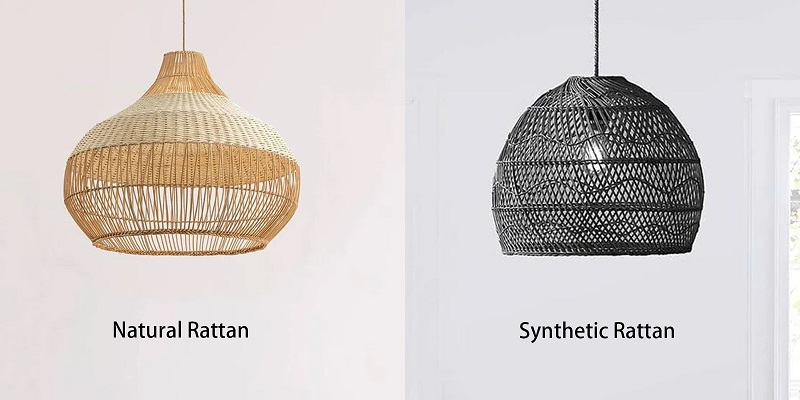
In some projects, synthetic rattan may be more appropriate than natural rattan when prolonged weather exposure is expected. Do not select outdoor lighting based on the appearance of the shade alone.
Natural Rattan Lamps vs. PE Rattan Lamps
7. Sustainability Can't Be Judged by Growth Speed Alone
Bamboo is frequently promoted as the more sustainable option because many bamboo species grow very quickly. Growth rate is relevant—but it isn't a complete environmental assessment.
For a finished lamp, sustainability can also depend on:
· Where the material was sourced
· Material processing
· Chemical treatments
· Product lifespan
· Packaging
· Transportation
· Repairability
· End-of-life disposal
Rattan also has an important ecological dimension. Some responsibly managed rattan systems can provide economic value from standing tropical forests because rattan grows as a climbing plant rather than requiring the same land-use model as plantation timber.
For B2B buyers making environmental claims, the safest approach is therefore: Ask for evidence about the actual supply chain instead of assuming “natural” automatically means sustainable.
Avoid unsupported phrases such as: “100% eco-friendly” or “zero environmental impact.”
Those claims are much harder to substantiate than simply explaining the material and sourcing process honestly.
8. What About Price?
There is no hard-and-fast rule stating that rattan products must be expensive or bamboo products must be cheap. For manufactured lighting, material is only one part of the cost.
The final quotation can be affected by:
· Design complexity
· Weaving hours
· Frame construction
· Size
· Finishing
· Electrical components
· Order quantity
· Packaging
· Certification requirements
A simple rattan shade can cost less to manufacture than a highly detailed bamboo pendant. Likewise, a complex rattan pattern requiring many hours of hand weaving can cost considerably more than a simple bamboo structure.
For wholesale buyers, compare the specific design, not the raw-material name.
9. Which Material Is Easier to Customize?
Both. But they offer different kinds of freedom.
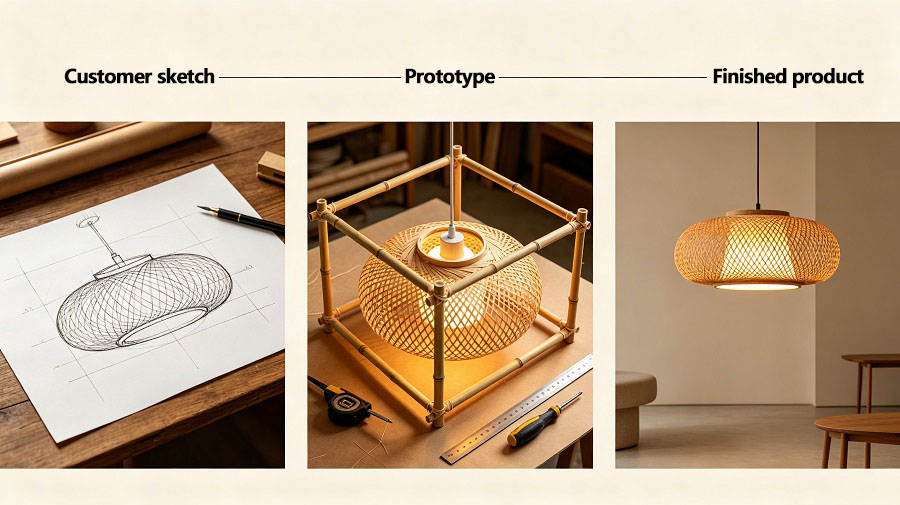
>> Custom rattan and bamboo lighting development from design sketch to finished prototype. <<
Choose Rattan When You Want:
· Complex curves
· Fine weaving
· Organic silhouettes
· Layered textures
· Sculptural forms
Choose Bamboo When You Want:
· Strong geometric lines
· Repetitive structures
· Architectural forms
· Visible natural nodes or strips
· A cleaner linear appearance
For some projects, we recommend combining them.
A manufacturer might use a more structural material for part of the form and a finer woven material for the decorative surface.
Buyers shouldn't feel forced to choose a single material when a hybrid construction solves the design problem better.
Rattan vs Bamboo Lighting for Different Projects
| Project | Usually Start With | Why |
| Beach resort | Rattan | Organic forms and relaxed texture |
| Japandi hotel | Bamboo | Structured, restrained visual language |
| Boho restaurant | Rattan | Complex weaving and decorative shadows |
| Tea house | Bamboo | Linear forms and natural architectural character |
| Boutique hotel lobby | Either | Depends on fixture scale and design |
| Custom sculptural installation | Rattan / Hybrid | Greater freedom for complex forms |
| Minimalist restaurant | Bamboo | Clean geometry |
| Large decorative chandelier | Either | Construction matters more than material name |
Notice that the table says “Usually Start With,” not “Must Use.” Professional lighting selection should leave room for the actual design.
A Better 5-Question Decision Framework
Before choosing rattan or bamboo, answer these five questions.
1. What shape are we trying to create?
Curved and intricate usually points toward rattan.
Structured and linear often points toward bamboo.
2. What should happen when the light is switched on?
Don't evaluate only the fixture when it's off. Specify the desired shadow, glare control, and atmosphere.
3. Where will the fixture be installed?
Indoor, covered outdoor, humid hospitality environment, and exposed outdoor applications require different construction decisions.
4. How many units are required?
A single decorative piece and a 500-room hotel project have very different consistency and production-control requirements.
5. Is this a catalog purchase or a custom development?
For OEM projects, let the manufacturer evaluate whether the requested material is actually the best engineering choice.
These five answers usually matter more than asking: “Which one is better?”
What We Look at Before Recommending Rattan or Bamboo
When XINSANXING receives a custom lighting inquiry, material selection should not begin with a predetermined answer.
We look at the project requirements first:
· Product dimensions
· Shape
· Weaving complexity
· Installation environment
· Target quantity
· Required visual effect
· Packaging limitations
· Target market
Only then does it make sense to recommend a material and construction method.
That's the difference between selecting a product from a catalog and engineering a product for a project.
Frequently Asked Questions
Not universally. Rattan is especially useful for curved forms and intricate weaving, while bamboo works particularly well for structured and geometric designs. The better choice depends on the fixture and project requirements.
There is no useful universal lifespan comparison. Material preparation, construction, surface treatment, humidity, UV exposure, and maintenance all affect service life.
Both can work well. Hotels seeking organic, highly textured lighting often choose rattan, while bamboo is particularly effective for structured, minimalist, or Asian-inspired concepts.
Natural-material fixtures should not automatically be treated as outdoor-rated. Outdoor suitability depends on material treatment and, critically, the electrical system and required protection rating.
Bamboo's rapid growth can be an advantage, but sustainability depends on the complete sourcing, processing, manufacturing, transportation, and product-life cycle. Material name alone isn't enough to support an environmental claim.
Yes. Hybrid construction can combine the characteristics of different natural materials and may be particularly useful in custom designs.
Neither is always cheaper. Labor, weaving complexity, fixture size, construction, components, packaging, quantity, and certification can influence the final price more than the raw material itself.
Rattan usually provides greater freedom for complex curved forms, while bamboo is particularly effective for structured geometry. A manufacturer should evaluate the actual drawing before recommending either.
Conclusion: Don't Choose the Material First—Choose the Result First
So, Rattan vs Bamboo Lighting: Which Is Better?
For professional buyers, that's actually the wrong question. A better sequence is:
1. What do we want the fixture to look like?
2. What lighting effect should it create?
3. Where will it be installed?
4. How many units do we need?
5. What production and maintenance requirements must it meet?
Then choose the material.
Rattan offers remarkable flexibility, intricate craftsmanship, and organic visual character. Bamboo provides structure, rhythm, natural geometry, and a distinctive architectural quality. Neither needs to defeat the other.
The right material is simply the one that allows the manufacturer to produce the right fixture for the right project.
Looking for a professional rattan lamp and bamboo lamp manufacturer?
Recommended Content:
Post time: Aug-19-2026