


Experienced manufacturers usually have a thorough understanding of every aspect, and even if you are not familiar with it, you can still smoothly carry out customized cooperation.
Customizing outdoor rattan lights involves three core elements—size, color, and logo—that directly impact installation suitability, market acceptance, compliance, and brand recognition. Many importers, wholesalers, and brand owners encounter avoidable issues during customization, such as ill-fitting sizes, color mismatches with local aesthetics, or non-compliant logos, leading to rework, shipping delays, and lost sales.
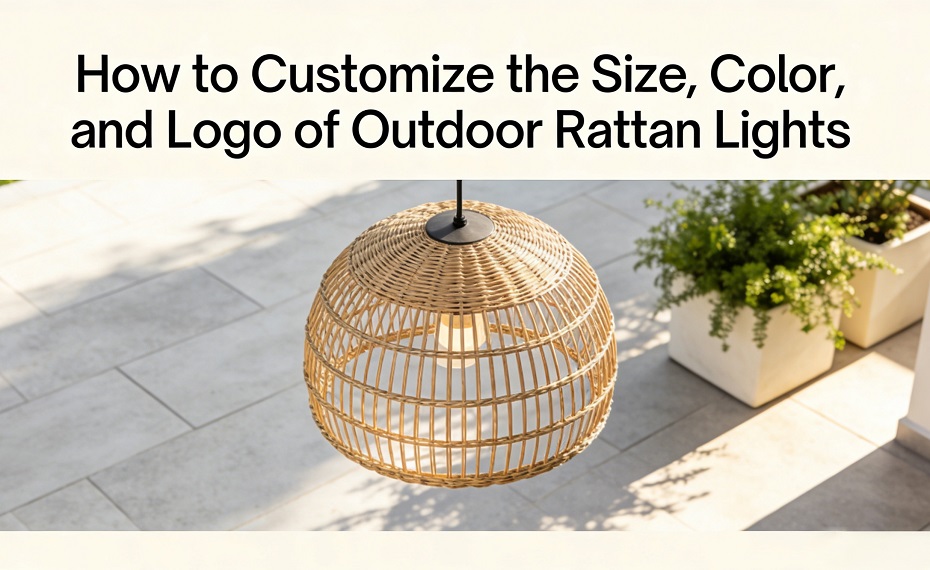
XINSANXING's Customization Guide for Outdoor Rattan Lighting offers practical and actionable advice on how to customize the size, color, and logo of your outdoor rattan light fixtures.
I. Size Customization: Balance Installation, Compliance, and Practicality
Size customization for outdoor rattan lights is not arbitrary; it must balance installation scenarios, shipping costs, and structural safety. Below are key principles and actionable steps for effective size customization:
Size customization for outdoor rattan lights is not arbitrary; it must balance installation scenarios, shipping costs, and structural safety. Below are key principles and actionable steps for effective size customization:
1. Define Installation Scenarios to Determine Basic Size Ranges
Different outdoor settings require specific size specifications. Blind customization increases costs and risks. Reference the following standard ranges for common scenarios:
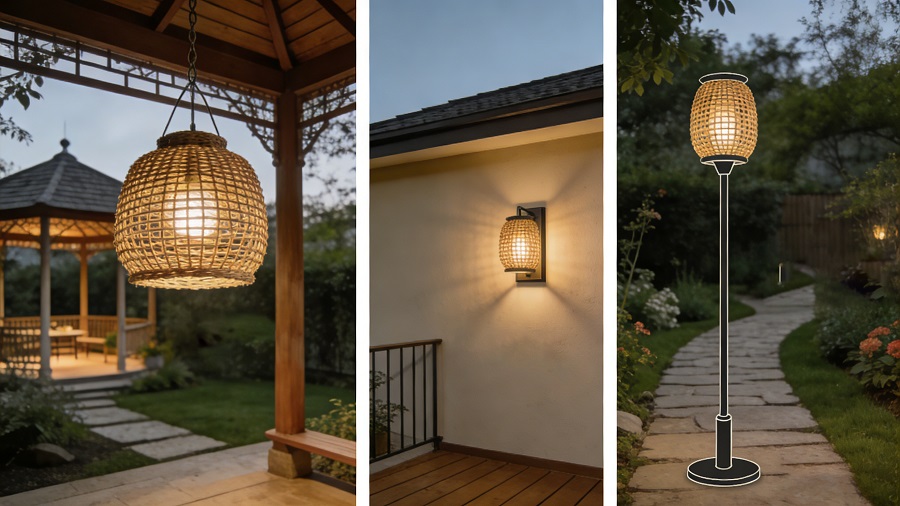
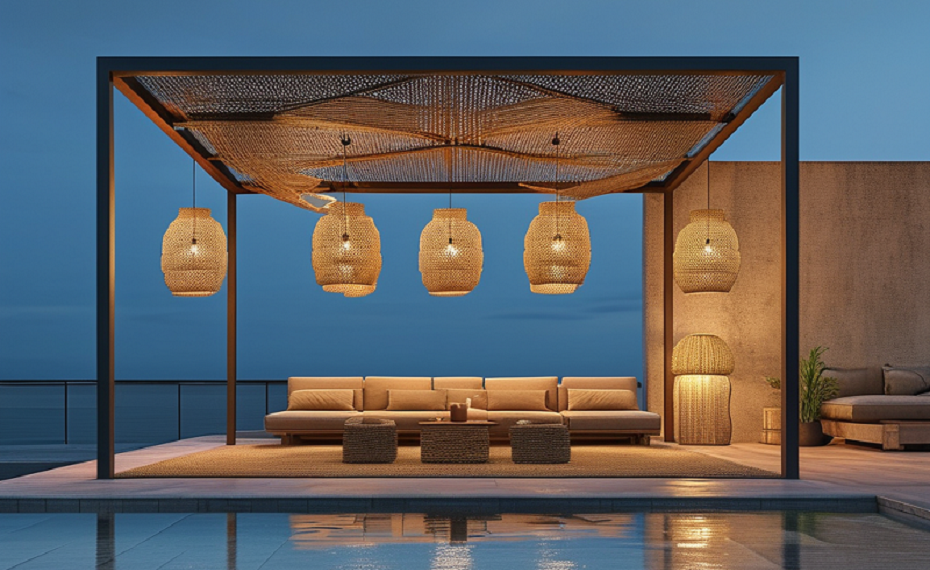
- Patio/Hanging Lights: 30-50cm in diameter and 25-40cm in height, suitable for standard patio ceiling heights (2.8-3.5m). Avoid oversized designs that block visibility or undersized ones that appear flimsy.
- Wall Sconces: 15-25cm in width and 8-15cm in depth, designed to fit flush against walls without occupying excessive space while ensuring adequate lighting coverage.
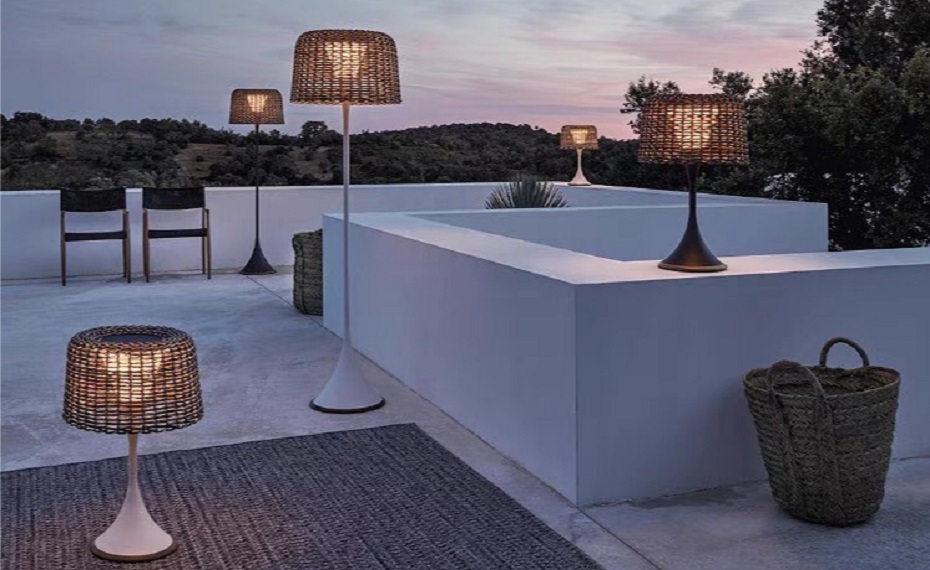
- Floor/Lawn Lights: 80-120cm in height and 20-30cm in base diameter, balancing stability (to prevent tipping in wind) and landscape harmony.
- Project Customization (Hotels/Parks): Sizes can be adjusted based on on-site dimensions, but installation drawings must be provided in advance to ensure structural load-bearing compliance, especially for large-scale rattan lights.
2. Key Limitations of Size Customization
Overly demanding size requirements often lead to production challenges or cost increases. Two non-negotiable limitations to consider:
① Rattan Weaving Constraints: Hand-woven rattan lights with a diameter exceeding 60cm are prone to loose weaving and deformation. The maximum recommended diameter is 80cm; larger sizes require reinforced frame designs.
② Shipping Constraints: Standard shipping containers have limited internal dimensions. Oversized designs require custom packaging, significantly increasing shipping costs. Prioritize standard size ranges where possible, and confirm feasibility with manufacturers for special sizes.
3. Effective Communication Tips for Size Customization
To avoid size discrepancies, provide three key pieces of information to manufacturers: photos/drawings of the installation scene, core dimensions (length/width/height/diameter), and load-bearing/installation requirements. Manufacturers will offer reasonable adjustments based on craftsmanship and shipping conditions.
II. Color Customization: Balance Market Adaptability and Weather Resistance
Color customization for outdoor rattan lights focuses on weather resistance and market adaptability. Outdoor exposure to sun and rain causes fading and yellowing, while aesthetic preferences vary significantly across overseas markets. Poor color choices directly impact end sales. Below are practical guidelines:
1. Color Selection: Align with Target Market Aesthetics
Prioritize colors that match local aesthetics over excessive personalization to boost sales. Key market preferences:
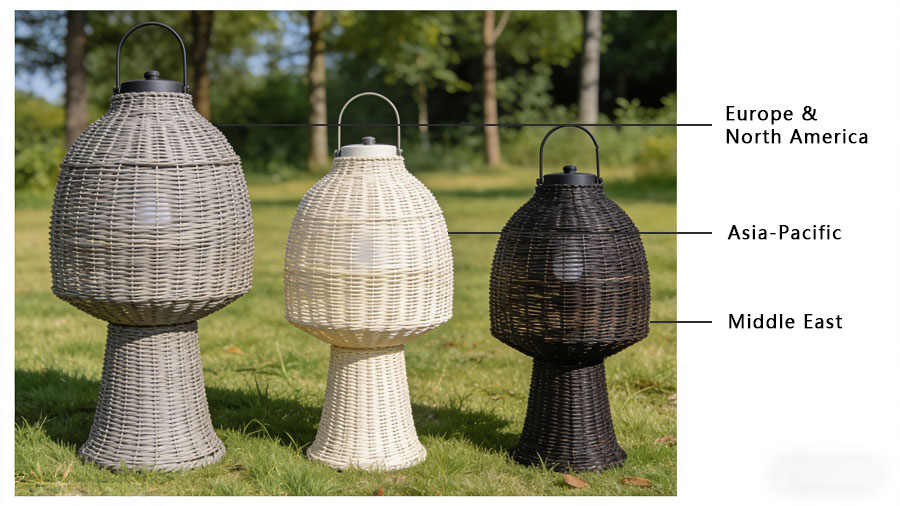
- European & American Markets (EU/US): Neutral tones (beige, light gray, dark brown) are preferred for their simplicity and compatibility with natural patio/lawn styles. Avoid overly bright colors.
- Asia-Pacific Markets (Japan/Southeast Asia): Light tones (cream, light blue) or simple color blocking (light gray + beige) work well, fitting Japanese minimalist and Southeast Asian tropical styles.
- Middle Eastern & Australian Markets: Dark tones (dark brown, dark green) are favored for their dirt resistance and compatibility with local high-temperature, high-UV environments, while enhancing texture.
2. Material-Color Compatibility: Weather Resistance is Key
Color durability depends on the material. Key considerations for different materials:
① PE Rattan (Mainstream Choice): Can be customized to any color. Use UV-stabilized color masterbatches to ensure 3-5 years of non-fading and non-yellowing, with uniform color.
② Natural Rattan: Primarily available in natural brown and light yellow. Minor dyeing is possible, but bright colors are not recommended. Additional anti-corrosion and UV treatments are required to prevent fading.
③ Metal Frames: Powder coating (matte black, light gray, bronze) is recommended for rust resistance and weather durability, avoiding spray painting (prone to peeling and fading).
3. Pitfalls to Avoid in Color Customization
① Provide Color Cards: Share PANTONE color codes or physical color samples with manufacturers to avoid color discrepancies from verbal descriptions.
② Confirm Samples: Always verify color samples under natural and artificial light to check for uniformity before mass production.
③ Avoid Dark Color Traps: Dark-colored rattan lights absorb heat, accelerating material aging in high outdoor temperatures. Pair dark colors with heat-dissipating metal frames.
III. Logo Customization: Balance Compliance, Clarity, and Durability
Logo customization is critical for brand differentiation, but it must meet target market compliance requirements and withstand outdoor conditions. Non-compliant logos often lead to customs detention or premature wear, resulting in significant losses. Below are key guidelines:
1. Three Main Logo Customization Processes (Choose Based on Needs)
Based on outdoor rattan light materials and usage scenarios, three durable and practical logo processes are recommended, avoiding easily peeling or unclear options:
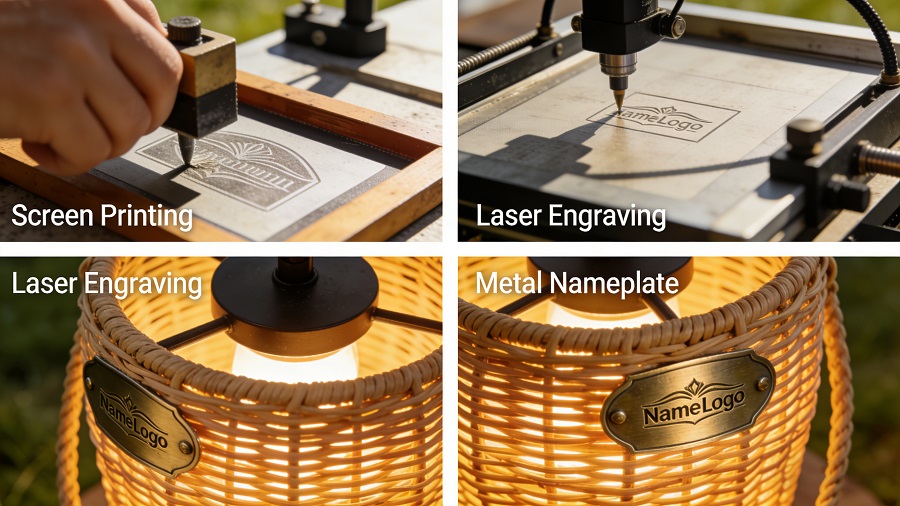
- Screen Printing: Suitable for flat surfaces (e.g., light bases, shades). Cost-effective and efficient with vibrant colors. Use UV-resistant inks to prevent fading from sun exposure.
- Laser Engraving: Ideal for metal frames and wooden bases. Produces clear, high-quality logos that resist peeling, suitable for simple text or graphics, and popular among high-end European and American brands.
- Metal Nameplates: Suitable for complex logos, available in raised or recessed designs. Mounted on light bases for exceptional durability, ideal for project orders and high-end customization.
2. Compliance Requirements for Logo Customization
Different markets have strict logo labeling requirements. Ignoring compliance risks customs issues. Focus on three key points:
① Size Requirements: Logo size must match the light’s dimensions—avoid being too small (unclear) or too large (aesthetically unpleasing). Standard size: 2-5cm (adjust based on light size).
② Compliance Labeling: EU markets require CE certification marks near the logo; US markets require UL certification numbers. Ensure the logo does not cover certification labels.
③ Copyright Requirements: Ensure the logo has no copyright infringement. Provide logo copyright certificates for manufacturers to verify feasibility.
3. Effective Communication Tips for Logo Customization
① Provide High-Resolution Logo Files: Prioritize vector files (AI, CDR) to ensure clarity when enlarged. If vector files are unavailable, provide high-definition PNGs (≥300dpi) for manufacturers to optimize.
② Specify Placement: Confirm the logo’s position (base, shade, frame) in advance to avoid covering certification labels, switches, or affecting the light’s structure.
③ Verify Samples: Check the logo’s clarity, color, and placement on samples before mass production to avoid rework.
Conclusion
The key to customizing outdoor rattan light size, color, and logo is balancing scenario adaptability, compliance, durability, and market fit: sizes should suit installation and shipping; colors should align with aesthetics and weather resistance; logos should enhance brand recognition while meeting compliance standards.
A critical best practice is to clarify three core factors before customization: target market, installation scenario, and budget. Communicate fully with manufacturers, verify samples (size, color, logo), and then proceed to mass production. This approach avoids 90% of customization pitfalls, ensures efficient order completion, and enhances competitiveness in overseas markets.
FAQs
No. Due to rattan weaving and shipping constraints, the recommended maximum diameter for standard rattan lights is 60cm, and the maximum height is 50cm. Sizes exceeding these require reinforced frames and will increase production and shipping costs. Always confirm feasibility with manufacturers in advance.
The key is to provide standard color cards and verify samples: Share PANTONE color codes or physical samples with manufacturers to avoid verbal description errors. After color customization, check samples under natural and artificial light for uniformity before mass production.
Laser engraving (for metal frames) and metal nameplates are preferred for their exceptional durability and resistance to peeling, making them suitable for outdoor sun and rain. Screen printing is a cost-effective option for simple logos but requires UV-resistant inks to prevent fading.
Vector files (AI, CDR) are preferred, as they remain clear when enlarged and are suitable for all processes. If vector files are unavailable, provide high-definition PNGs (≥300dpi), and manufacturers will assist with optimization.
PE rattan can be customized to any color, making it the most versatile option. Natural rattan is limited to minor dyeing in natural tones and cannot be customized to bright colors. Metal frames are best suited for powder-coated matte or dark colors for rust and weather resistance.
Costs: Standard size and color customization do not incur additional costs. Special sizes (over 80cm), custom colors (special Pantone codes), and metal nameplate logos increase costs by 5%-15%. Lead Times: Sample confirmation takes 3-7 days, and mass production lead times are 3-5 days longer than standard orders, depending on customization complexity.
Focus on two key points: First, ensure the logo size matches the light and does not cover CE, UL, or other certification labels. Second, confirm the logo has no copyright infringement and provide copyright certificates. For EU and US markets, label corresponding certification numbers near the logo to avoid compliance risks.
Looking for An Experienced Custom Outdoor Rattan Light Manufacturer?
Recommended Content:
If You Are in Business, You May Like
Post time: Apr-02-2026