


If you are searching for outdoor rattan lamps that meet the specific certification requirements of your local market, XINSANXING would be delighted to assist you. Please let us know your target market region, and we will provide you with lighting solutions precisely tailored to your needs.
Outdoor rattan lighting fixtures constitute a highly sought-after category in modern international trade. However, as products possessing a dual nature—combining electrical components with rattan craftsmanship—they must undergo specific compliance certification for each target export market. Failure to do so carries the risk of customs clearance delays, fines, or even outright sales bans.
Follow this expert guide from XINSANXING—a leading manufacturer of outdoor rattan lighting—which incorporates the latest regulations for 2026. Categorized by target market, this guide pinpoints the core certification requirements and practical operational essentials for each region, empowering international trading enterprises and wholesale buyers to precisely mitigate risks and enhance their export competitiveness.
I. The Core Significance of Export Certification
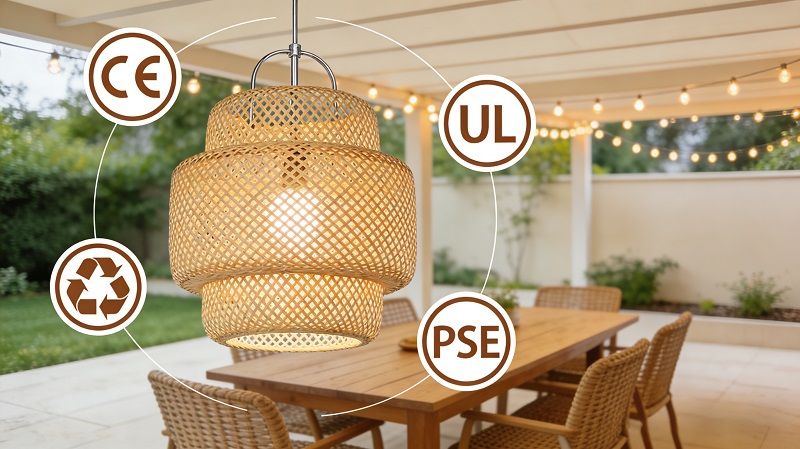
Outdoor rattan lighting fixtures must meet specific requirements regarding electrical safety, weather resistance, and environmental compliance. Export certification serves as official validation across various markets and constitutes a primary criterion used by overseas buyers when vetting suppliers; products bearing such certification instill the utmost confidence in customers.
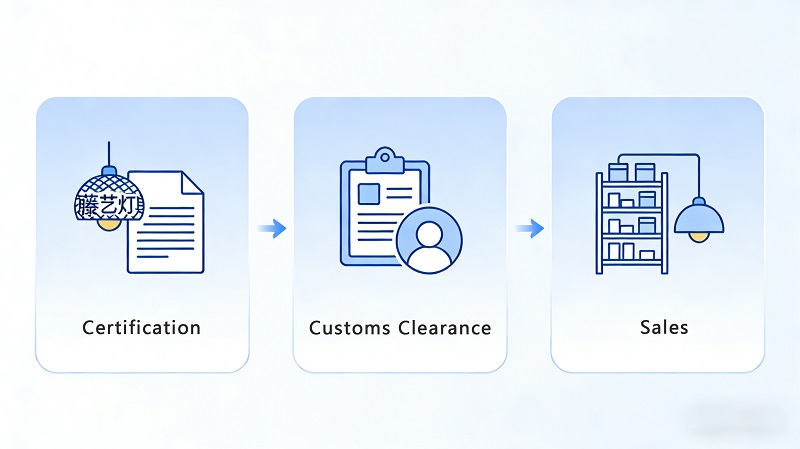
《Diagram Illustrating the Export Customs Clearance Process for Outdoor Rattan Lighting Fixtures》
II. Core Certifications for Different Regions
There’s a reason outdoor rattan light has exploded in popularity among homeowners and decor enthusiasts alike. Here are the biggest benefits of adding outdoor rattan light to your patio, garden, or balcony—benefits that make them a smart choice for both style and function.
II.1. EU Market: CE Certification (Mandatory) + Core Supplementary Requirements
1. Low Voltage Directive (LVD) — Core Electrical Safety
Lighting fixtures with a rated voltage between 50V–1000V AC or 75V–1500V DC must pass tests such as insulation withstand voltage (≥2500V AC with no breakdown) and temperature rise control. The applicable standards are EN 60598-1 and EN 60598-2-20; LED models must additionally comply with EN 61347-2-13 and EN 62031.
2. Electromagnetic Compatibility Directive (EMC) — Interference Control
Lighting fixtures containing electronic components must pass EMI (radiated emissions ≤44dBμV/m) and EMS tests. The applicable standards are EN 55015 and EN 61547; a complete test report must be provided.
3. Energy-related Products Directive (ErP) — Energy Efficiency Requirements
Outdoor LED rattan lighting fixtures must meet a luminous efficacy of ≥80lm/W and a Color Rendering Index (Ra) of ≥80. They must be labeled with an energy efficiency class ranging from A to G; non-compliant products will be prohibited from sale.
4. Environmental Directive (RoHS 2.0) — Restriction of Hazardous Substances
Rattan, metal, and electrical components must restrict the presence of 10 hazardous substances (e.g., Lead ≤0.1%, Cadmium ≤0.01%). Testing is required for all homogeneous materials.
Additional Requirements:
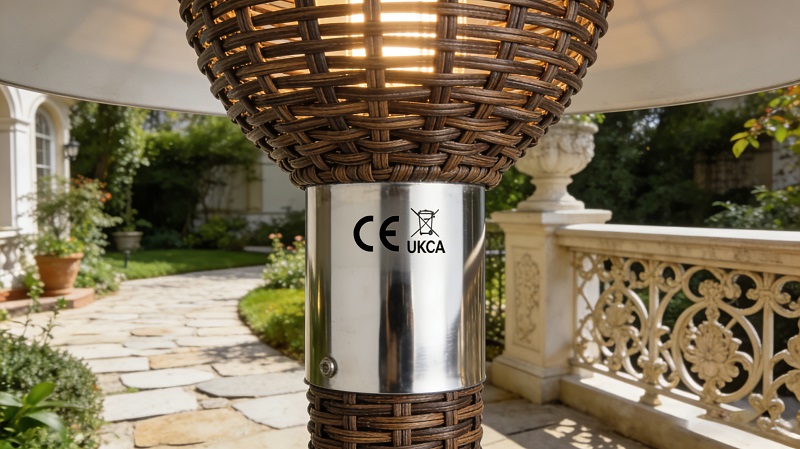
For the UK market, the UKCA mark must be affixed (Northern Ireland may continue to use the CE mark). Lighting fixtures intended for close-range illumination must pass the EN 62471 photobiological safety test (RG0 classification). Outdoor lighting fixtures must achieve a minimum dust and water protection rating of IP65; for coastal regions, an IP67 rating is recommended.
II.2. North American Market: UL/ETL + FCC + Energy Efficiency Certification (Mandatory)
The United States and Canada impose strict safety requirements on outdoor lighting fixtures; without the corresponding certifications, products cannot access mainstream distribution channels. The core certifications include:
1. UL/ETL Certification — The Core of Safety
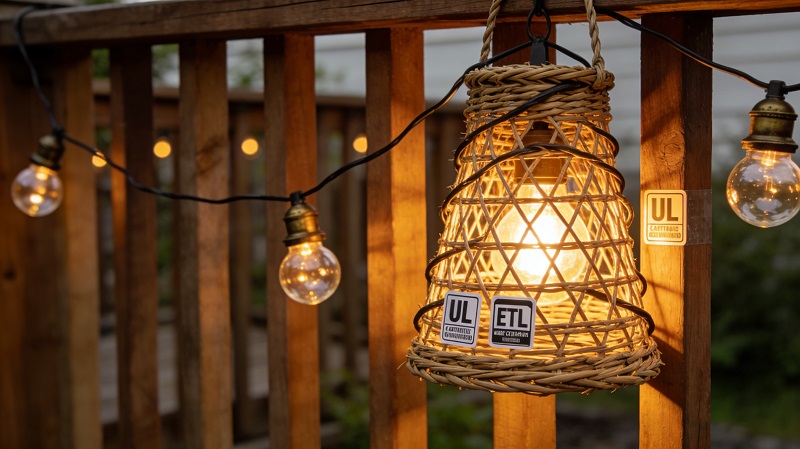
UL Certification (Mainstream in the US): Fixed luminaires must comply with UL 1598; low-voltage models must comply with UL 1838; and LED drivers must comply with UL 8750. Products are required to pass heat resistance, voltage resistance, and fire safety tests, bear the UL mark, and undergo periodic surveillance. ETL Certification is equivalent to UL; the process is faster and the cost is lower. For Canada, an additional cUL certification is required (compliance with CSA C22.2 No. 108).
2. FCC Certification — Electromagnetic Compatibility (EMC)
Lighting fixtures containing electronic components must undergo FCC-SDoC certification. LED models must comply with FCC Part 15B, while models featuring wireless remote controls must comply with FCC Part 15C; submission of a test report is sufficient.
3. Energy Efficiency Certification — DOE + CEC
US DOE Certification (Mandatory as of 2025): Products must comply with the 10CFR430.32 standard. For California, products must additionally meet CEC energy efficiency standards. Although Energy Star and DLC certifications are voluntary, they can significantly enhance product competitiveness and boost traffic on e-commerce platforms.
Additional Requirements:
Platforms such as Amazon strictly mandate the submission of UL/ETL test reports; lighting fixtures containing lithium batteries must pass UN38.3 certification, and corresponding MSDS documents must be provided.
II.3. Asia-Pacific Market: Japan PSE, Australia SAA + Voluntary Certifications for Southeast Asia
1. Japan Market: PSE + TELEC Certification
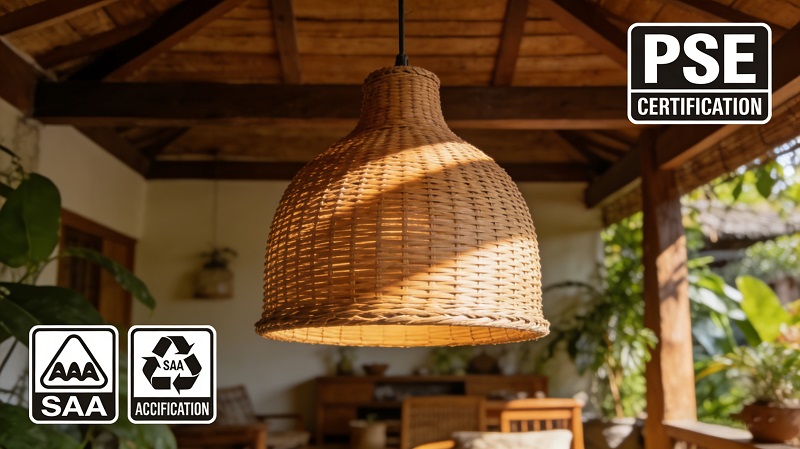
PSE certification is mandatory. Most complete outdoor rattan lighting fixtures fall under Class B (Round Certification) and must comply with the JIS C 7601 standard. Models featuring wireless remote controls require additional TELEC certification; they must also be accompanied by Japanese-language instruction manuals and comply with RoHS requirements.
2. Australia & New Zealand Market: SAA Certification (Mandatory)
Products must comply with the AS/NZS 60598 series of standards, successfully pass electrical safety and EMC testing, bear the SAA mark, and be compatible with 240V, 50Hz power supplies.
3. Southeast Asia Market: Voluntary Certification + Basic Compliance
Certifications such as Indonesia's SNI, Malaysia's SIRIM, and Thailand's TISI are technically voluntary; however, without them, gaining entry into mainstream markets is extremely difficult. The primary focus should be on rigorous electrical safety and weather resistance testing, as well as enhancing the IP protection rating, to mitigate customs clearance risks.
II.4. Other Markets: Key Certification Focus Areas
Middle East: Saudi SASO and UAE ESMA certifications; IP65 rating plus high-temperature resistance.
Africa: South Africa SABS and Nigeria SONCAP certifications.
South America: Brazil INMETRO and Argentina IRAM certifications; both place a primary focus on electrical safety.
III. General Requirements for All Markets
III.1. Material Compliances
Rattan materials (whether natural rattan or PE synthetic rattan) must be eco-friendly and weather-resistant. They must pass UV aging and salt spray tests. PE synthetic rattan must comply with RoHS standards, while natural rattan requires the provision of sustainable harvesting certificates (which may be requested by EU buyers).
III.2. Electrical Component Compliance
Electrical components—such as wires, plugs, and LED drivers—must comply with the standards of the target market. Corresponding component certification certificates must be provided. Batteries for solar lighting fixtures must be of the Lithium Iron Phosphate (LiFePO4) type and bear a label stating: "Replacement by professional personnel only."
III.3. Labeling and Instruction Manual Compliance
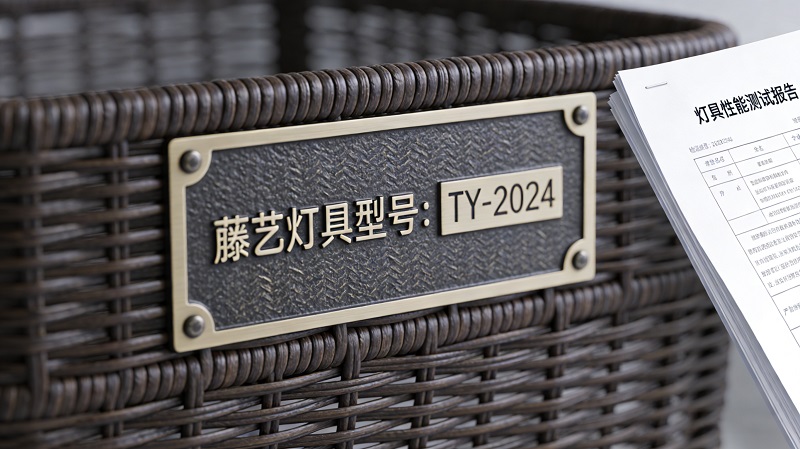
The product nameplate must clearly display information such as certification marks, model numbers, and voltage ratings. Instruction manuals must be provided in the language of the target market. For the EU market, an EC Declaration of Conformity must be prepared and retained for a period of 10 years.
III.4. Retention of Test Reports
Technical documentation—including third-party test reports, design drawings, and declarations of conformity—must be retained to facilitate regulatory inspections. For the EU market, the contact details of the EU Authorized Representative (or UK Authorized Representative) must be clearly indicated.
IV. Global Overview of Export Certification for Outdoor Rattan Lighting Fixtures
| Regions | Core Markets | Mandatory Certifications |
| Europe | EU 27 + UK | CE (LVD+EMC+ERP+RoHS), UKCA |
| North America | USA, Canada | UL/ETL, FCC, DOE/CEC, cUL |
| Asia-Pacific | Japan, Australia/New Zealand, Southeast Asia | PSE (Japan), SAA/RCM (Australia/NZ), SNI/SIRIM/TISI (Southeast Asia) |
| Middle East | Saudi Arabia, UAE | SASO (Saudi Arabia), ESMA (UAE) |
| Africa | South Africa, Nigeria | SABS (South Africa), SONCAP (Nigeria) |
| South America | Brazil, Argentina | INMETRO (Brazil), IRAM (Argentina) |
Conclusion
In 2026, compliance requirements across various markets are expected to continue tightening. Export certification serves as the critical gateway for outdoor rattan lighting fixtures to clear customs and gain entry into mainstream markets; meeting the specific certification standards required by target markets is essential for enhancing competitiveness, mitigating risks, and achieving business growth.
Looking for a certified manufacturer of outdoor rattan lamps?
If You Are in Business, You May Like
Post time: Mar-25-2026