


Would you like me to create a customized "Lighting Layering Plan" for your specific floor plan, or would you like to see our latest 2025 catalog of Rattan and LED fixtures?
The Difference Between Pendant Lights and Ceiling Lights: The Ultimate Professional Guide
In the realm of architectural lighting and interior design, the choice between pendant lights and ceiling lights is far more than a simple aesthetic preference. It is a strategic decision that affects the spatial volume, the functionality of the light, and the psychological comfort of the occupants.
As professional lighting manufacturers at XINSANXING Light Factory, we understand that selecting the right luminaire (lighting fixture) requires a balance of technical specifications and design intent. This comprehensive guide will dissect the fundamental differences, technical nuances, and application strategies for both pendant and ceiling-mounted fixtures.
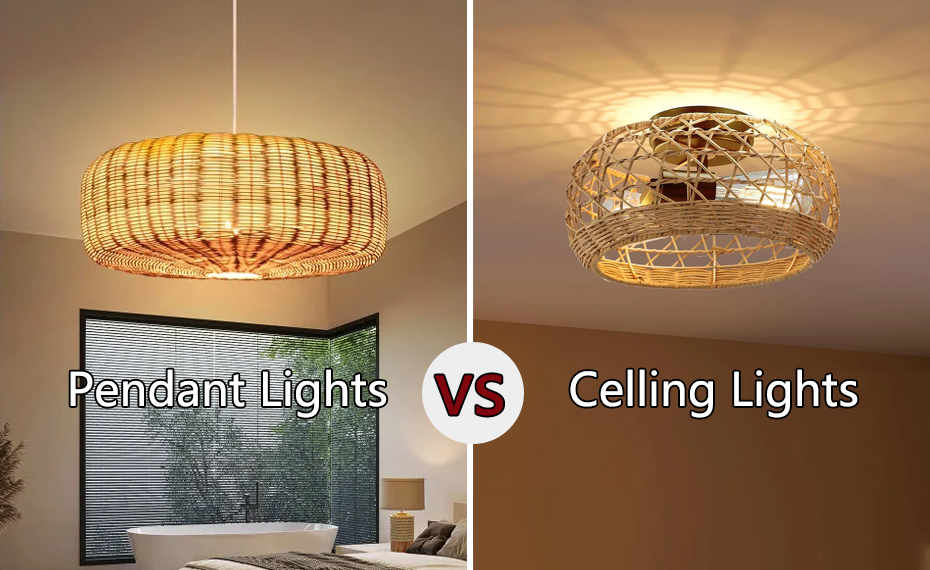
1. Defining the Core Concepts
To understand the difference, we must first define the physical and functional characteristics of each category.
What is a Pendant Light?
A pendant light is a singular light fixture that hangs from the ceiling, usually suspended by a cord, chain, or metal rod. Think of it as the "jewelry" of a room—it is designed to be noticed and often acts as a focal point.
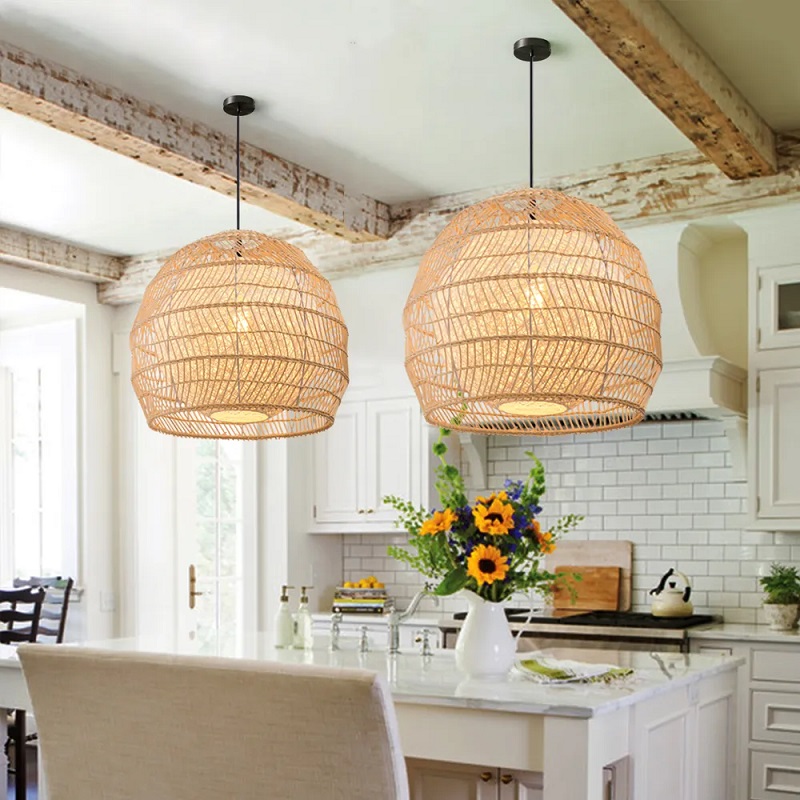
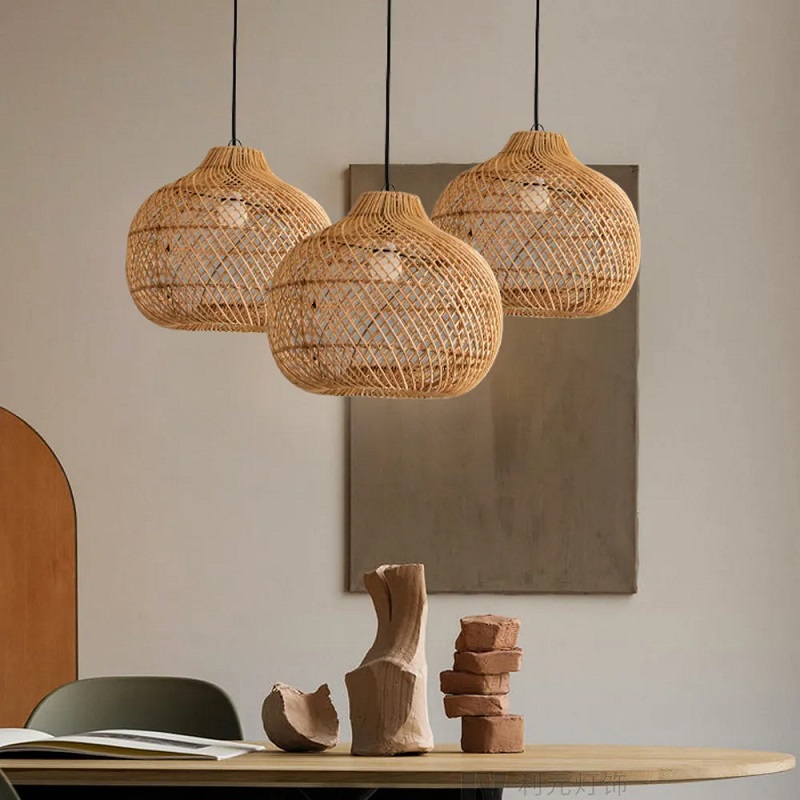
Modern rattan pendant light suspended by a black cord over a minimalist dining table.
What is a Ceiling Light?
Ceiling lights, often referred to as flush mounts or semi-flush mounts, are fixtures that sit directly against the ceiling or very close to it. They are the "workhorses" of lighting, designed to provide broad, even illumination without occupying vertical space.
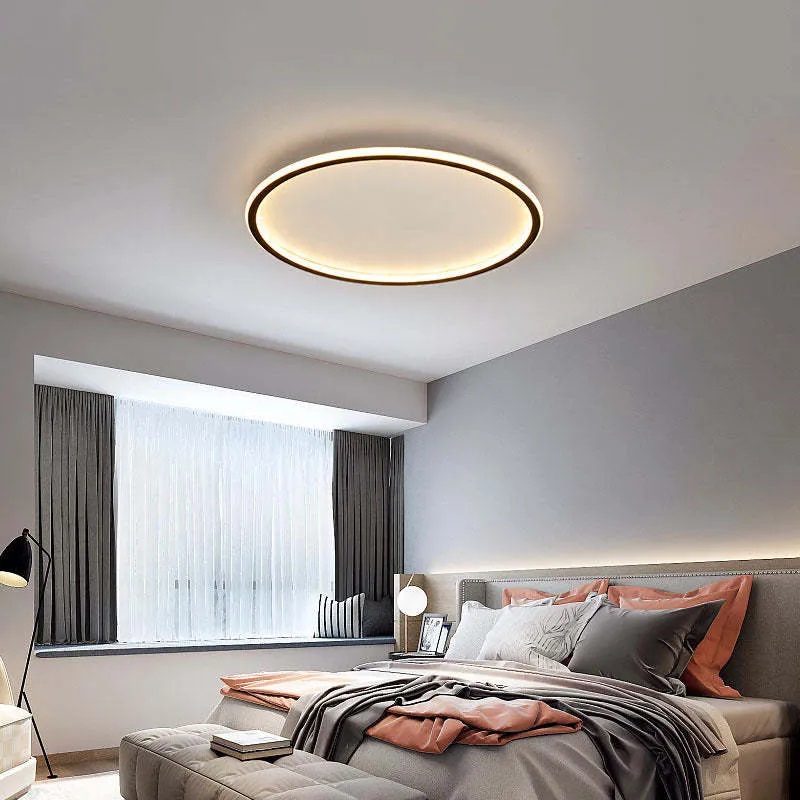
Ultra-thin LED flush mount ceiling light providing wide-angle ambient illumination.
2. Technical Comparison: Mounting and Spatial Requirements
The most immediate difference lies in how these fixtures interact with the physical dimensions of a room, specifically ceiling height.
Vertical Clearance
Pendant Lights: These require significant vertical space. A standard rule in lighting design is that the bottom of a pendant should hang approximately 30 to 36 inches above a surface (like a table) or at least 7 feet above the floor to prevent obstruction.
Ceiling Lights: These are the optimal solution for low ceilings (under 8 feet). Because they hug the ceiling, they maintain an open sightline and make a small room feel larger.
Installation Mechanics
From a technical standpoint, both fixtures typically connect to a standard junction box. However, pendant lights often require more precise "scaling." The weight of a large pendant (especially those made of heavy materials like brass or solid glass) may require a reinforced junction box or additional support structures.
3. Light Distribution and Functional Intent
The way light leaves the fixture defines the "mood" of the space. This is where the technical difference becomes a design tool.
Task Lighting vs. Ambient Lighting
Pendant Lights (Task-Oriented): Most pendants are designed for task lighting. Because they are closer to the surface, they provide a concentrated beam of light perfect for reading, cooking, or dining.
Ceiling Lights (Ambient-Oriented): Ceiling lights excel at ambient lighting. They often feature diffusers (frosted glass or acrylic) that scatter light in a 180-degree radius, filling the room with a soft, shadow-less glow.
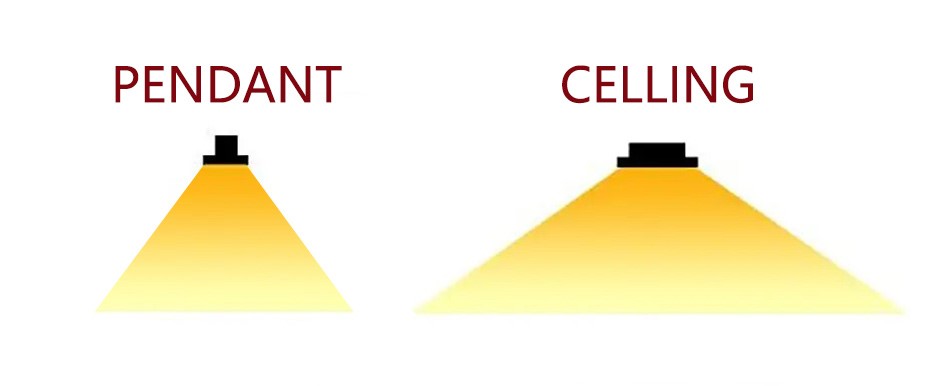
The difference in beam angle between pendant lights and ceiling lights.
4. Aesthetic Impact and Design Styles
The way light leaves the fixture defines the "mood" of the space. This is where the technical difference becomes a design tool.
The Statement Piece (Pendant)
Pendants are used to define zones within an open-concept layout. For example, a row of three pendants can visually "wall off" a kitchen island from a living area.
Trend Alert: Rattan pendant lights have surged in popularity for 2024-2025. Their organic texture breaks the monotony of modern minimalist architecture, casting intricate "woven" shadows that add depth to a room.
The Subtle Integrator (Ceiling Light)
Ceiling lights are about integration, not interruption. In high-traffic areas like hallways, bathrooms, or closets, a ceiling light provides the necessary lumens without becoming a physical or visual hazard.
5. A Deep Dive into Materiality: The Rise of Rattan
As a lighting factory, we have observed a shift toward natural materials in both pendant and ceiling categories.
| Feature | Rattan Pendant Light | Rattan Ceiling Light (Semi-Flush) |
| Visual Weight | High - Acts as a hanging sculpture | Medium - Adds texture without bulk |
| Shadow Effect | Dramatic, radial patterns | Subtle, ceiling-grazing patterns |
| Best For | Dining rooms, entryways | Bedrooms, cozy nurseries |
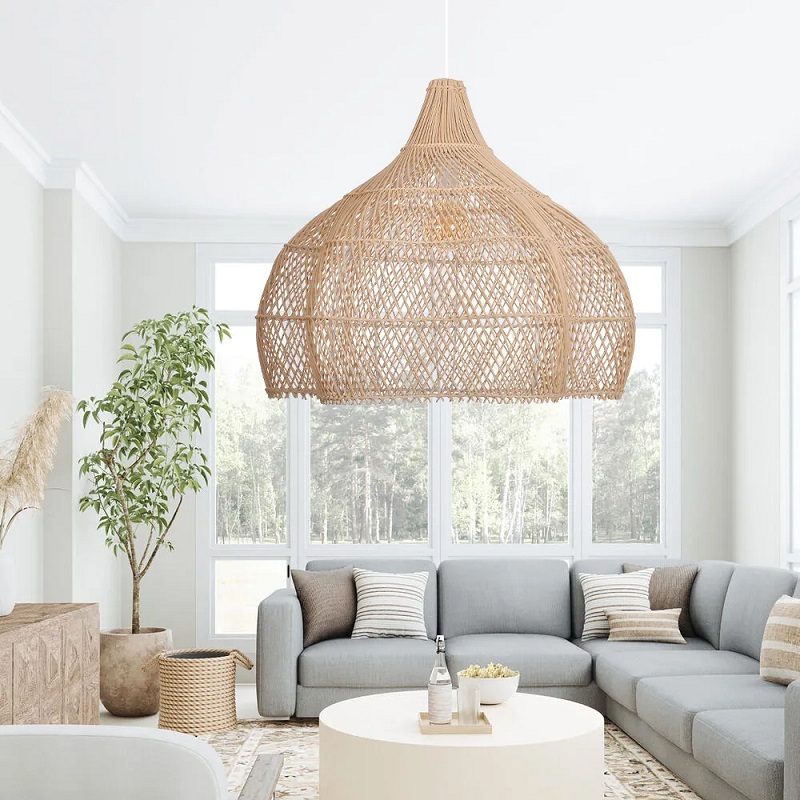
Large handmade rattan pendant light used as a focal point in a coastal interior design.
6. Lumens, Kelvins, and Technical Specs
When specifying these lights for a commercial project, the "look" is secondary to the "output."
The Lumen Calculation
For a standard room, you can calculate the required lumens using this formula:
Total Lumens = Room Area (sq. ft.) × Footcandles
· Pendant lights often require fewer lumens because the light source is closer to the task area.
· Ceiling lights require higher lumen output to overcome the distance from the floor and ensure corner-to-corner visibility.
Color Temperature (CCT)
· Pendant Lights: Often paired with "Warm White" (2700K) to create an intimate, hospitable atmosphere.
· Ceiling Lights: Often used with "Neutral White" (3000K - 3500K) to provide a clean, energetic feel for daily activities.
7. Pros and Cons: A Quick Reference Table
| Category | Pros | Cons |
| Pendant Light | Exceptional style, great task lighting, defines space. | Can be a head-strike hazard, harder to clean, requires high ceilings. |
| Ceiling Light | Saves space, easy maintenance, provides uniform light. | Can feel "flat" or boring, lacks focused illumination. |
8. How to Choose
To decide which is right for your project, ask these three questions:
What is the ceiling height?
· Under 8 feet? Go with a ceiling light.
· Over 9 feet? A pendant will fill the "dead space" beautifully.
What is the primary activity in the room?
· Detail work (Cooking/Writing)? Pendant.
· General movement (Hallway/Laundry)? Ceiling light.
Do you already have a focal point?
· If the room has a dramatic fireplace or a large window, a subtle ceiling light won't compete for attention.
· If the room feels "empty," a pendant adds the necessary character.
9. Maintenance and Longevity
From a manufacturing perspective at XINSANXING, we prioritize durability.
Pendant Maintenance: Dust tends to collect on the top of the shades. Since they hang lower, they are easier to reach with a hand-duster but more prone to being bumped during cleaning.
Ceiling Light Maintenance: These are generally "set and forget." High-quality LED flush mounts can last up to 50,000 hours, meaning you may never need to open the fixture for 15+ years.
Conclusion: Harmonizing the Two
The most successful lighting designs don't choose one over the other; they combine both. Using ceiling lights for general brightness and pendants for specific "pools" of light creates a sophisticated, layered environment.
At XINSANXING, we provide a diverse range of both pendant and ceiling solutions—from industrial-grade LED fixtures to artisan-woven rattan designs. Understanding these differences allows you to move beyond "just lighting a room" to "designing an experience."
Need a Professional Lighting Layout?
Recommend Reading:
Post time: Dec-23-2025